


Organizations are at an inflection point when it comes to the service experience. Enhancing the customer relationship requires a new engagement model where service management and customer experience unite to transform and differentiate the brand in a disrupted competitive environment.
Introduction
The field and customer service operation has seen a dramatic shift in the past 15 months. Due to the pandemic, the ability to physically get access to equipment or a customer site has been limited or, in some cases, restricted completely. As regions of the world reemerge into a “next normal” state at different rates, organizations will operate using a variety of service models that rely on remote resolution, collaboration, and engagement.
A change is occurring across industries whereby the customer experience is becoming a critical differentiator, and the way organizations engage customers will become a higher priority. Customers expect organizations to solve the stated problem efficiently and enhance the experience by going beyond the work order to establish a partnership that requires little effort on the customer’s part.
In this transformed business landscape, manufacturers and service organizations will need to address the following challenges to achieve success and relevance with customers:
- Enabling data and knowledge accessibility for all relevant stakeholders
- Eliminating silos across service, customer support, and other functions that hinder a shared and enhanced customer experience
- Automating manual processes and static work instructions that delay responses and resolution
- Contending with an aging workforce and a related knowledge drain
- Addressing the need to be more customer focused to personalize experiences and deliver enhanced value at each engagement point
- Providing service employees and customers with new tools that optimize remote and self-solve support, moving from a reactive break/fix service model to a more proactive and predictive approach
Figure 1 highlights some of the top business priorities for manufacturers and service organizations in this “next normal” environment.
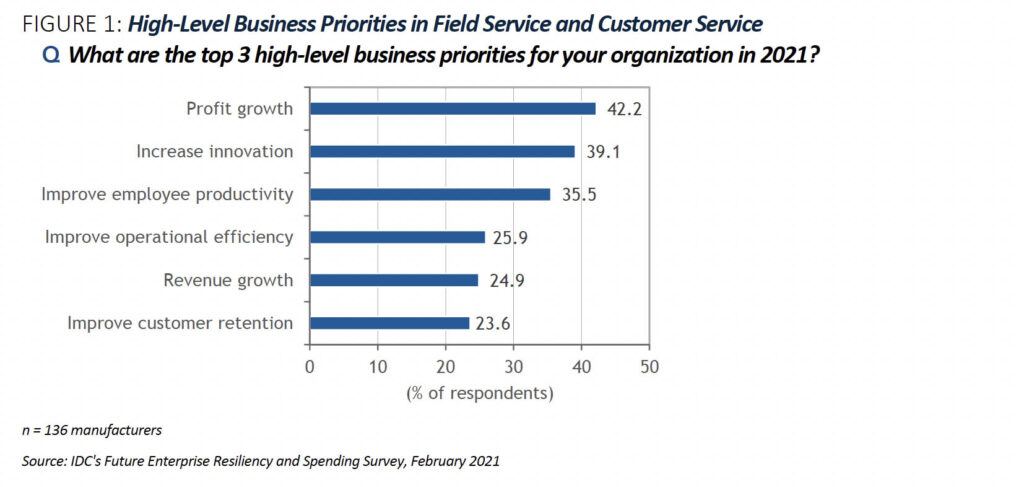
Manufacturers and service organizations need to manage various priorities to ensure they can survive, thrive, and excel in a competitive environment where customer expectations continue to rise.
Benefits
Service management with field technicians — and directly with customers — has long been held back by a reactive break/fix model. In this model, customers have to notify the service organization of a failure or a break. The field service team then must attempt to solve the issue with limited information gleaned from the customer or historical data from the last service visit. This process typically involves dispatching a service technician or engineer to a customer site to validate a diagnosis, often leading to a secondary or tertiary service call. Real-time visibility into the product or asset with detailed collaborative capabilities can transform the service and customer experience.
The shift from reactive service models to proactive service experiences has an impact that transcends operational efficiency to enhance the customer relationship. Establishing an operating model where the customer and the service employee are at the heart of the service experience is transformative and can be a true industry differentiator. This framework establishes a new partnership of shared goals, outcomes, and experiences that optimize service and deliver new value.
Connected service insights are part of the innovative future for manufacturers and service organizations. A few of the most impactful benefits derived from this approach are:
- Having the right content and insights at the point of need, which speeds up service resolution and avoids the need to sift through irrelevant manuals and work instructions with reactive and proactive service interactions
- Capturing and then sharing institutional knowledge, which minimizes the impact of an aging or retiring field and service workforce
- Improving increased first-time fix and lower mean-time-to-resolution metrics, which enhances the customer experience through proactive support
- Avoiding unnecessary truck rolls that impact fuel usage, emissions, and safety, which helps improve operations
- Establishing an emotional and personalized bond between the service team and the customer through contextual awareness of the problem at hand, integration of a full view of the customer, and self-service experiences
As these varied benefits work together, the business can offer differentiated service outcomes, enhanced experiences, and an engaged workforce equipped with the knowledge to improve quality service and brand experience.
In the next feature in this series we will be taking a deeper dive into digital services and new digital-first customer experiences.
Want to know more and can’t wait? Field Service News Subscribers on both our PRO and FREE subscription tiers can access the full white paper now on the button at the top of this article.
This content is sponsored by CareAR
 Data usage note: By accessing this content you consent to the contact details submitted when you registered as a subscriber to fieldservicenews.com to be shared with the listed sponsor of this premium content CareAR who may contact you for legitimate business reasons to discuss the content of this white paper.

Turning knowledge into action for the manufacturing industry.